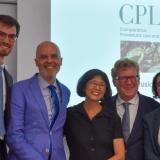
CPLJ Hero
CPLJ Banner

Comparative Procedural Law and Justice (CPLJ) is a global project on comparative civil justice, organized by the Max Planck Institute Luxembourg for Procedural Law and supported by the Luxembourg Research Fund FNR (FNR – O19/13946847). 

Officially launched in September 2020, it was the flagship research project of the Department of European and Comparative Procedural Law of the Max Planck Institute Luxembourg, led by Burkhard Hess. In January 2024, the Max Planck Institute Luxembourg and CPLJ were transferred to the University of Luxembourg. The University took then responsibility as Coordinating Institution until in August 2024.

Burkhard Hess was the founding director of the Max Planck Institute for Procedural Law where CPLJ was originally launched. Since September 2024, he has been continuing the project as leading editor from his new chair and with the assistance of his team at the University of Vienna.
NEW: The Hague Academy of International Law - General Course Lectures

Judicial Communication - A Global Visit of the Webpages of National and International Courts

Burkhard Hess
Judicial Communication - A Global Visit of the Webpages of National and International Courts

Judicial communication aims at making justice understandable and accessible by proactively engaging the wider public through courts' physical spaces and digital presence. The lecture spans a comparative look at court architecture as civic symbols and a survey of court websites worldwide, including their content, functions, multilingual access, user experience design, and use of social media. It highlights the emergence of communication as a core judicial task and the profound changes driven by digitalisation, including transparency practices and public-facing narratives. Procedurally, it covers the institutionalisation of communication within judiciaries, such as spokespersons, guidelines, and media strategies, and situates these developments within comparative procedural law research. Key hurdles include balancing openness with judicial independence and neutrality, safeguarding privacy and data protection, addressing the digital divide and misinformation risks, and managing resource constraints.

With the courtesy of the Hague Academy of International Law
Jean-Marc Thouvenin, Secretary General


Strategic Litigation - A New Phenomenon in International Dispute Resolution

Burkhard Hess
Strategic Litigation: A New Phenomenon in dispute Resolution?
Examples, Tactics, and Procedural Challenges

Strategic litigation aimes at societal and legal changes through lawsuits often organized and funded by NGOs, communities, and ombudspersons rather than individuals alone. The lecture spans examples from the Belgian deportees before Mixed Arbitral Tribunals in the 1920s to modern climate cases like KlimaSeniorinnen, Juliana v US, Neubauer v Germany, and the ICJ's Advisory Opinion in 2025. It highlights the professionalisation of NGOs and media-focused communication using individual narratives. Procedurally, it covers collectivization models driven by EU developments and corporate due diligence, with civil liability frameworks, and addresses forum choice strategies. Key hurdles include the limited standing of NGOs, their role of amici curiae, and anti-SLAPP safeguards.

With the courtesy of the Hague Academy of International Law
Jean-Marc Thouvenin, Secretary General

CPLJ Project Description

CPLJ was envisaged as a comprehensive study of comparative civil procedural law and civil dispute resolution schemes in the contemporary world. It aimed at understanding procedural rules in their cultural context, as well as at highlighting workable approaches to the resolution of civil disputes. It focused on recent developments in the field of comparative civil procedure from a global perspective. These included the influence of Information Technologies and Artificial Intelligence; the expansion of alternative dispute resolution; the most recent trends on access to justice; the challenges of collective litigation; and the growing needs for transparency and independence of the justice systems. The cultural dimensions and the methodology of comparative civil procedural law received specific attention.

The ultimate goal of the project was to produce a multi-volume Publication on Comparative Procedural Law and Justice accessible online. The Publication, to be released in full in autumn 2024, is expected to illustrate the consolidation of comparative civil procedural law as a self-standing research area and aspires to become one of the main sources of reference for future studies.

Video Tour of the CPLJ Website

A video tour of the CPLJ website, showcasing the central features of the online publication viewer.